
Tuesday, December 24, 2013

Saturday, December 21, 2013
Getting there and around Seoul
Flights, tours and rail tickets can be booked online. An alternative to walking and the subway is provided by the Seoul City Tour Bus. Taxis are inexpensive and don’t expect a tip, but finding an available one can take time.
Local transport
Taxi
Regular taxis are a good deal and are cheaper than the bus or subway for three people making a short trip. Regular taxis (ilban) cost W1900 for the first 2km and then W100 for every 144m or 41 seconds afterwards. A 20% surcharge is payable between midnight and 4am. Deluxe taxis (mobeom) are black with a yellow stripe and cost W4500 for the first 3km and then W200 for every 205m or 50 seconds, and don’t have a late-night surcharge. There are plans to drop these fixed prices in 2006 and if this happens taxis will charge varying prices.Few drivers can speak English, but some taxis have a free interpretation service - you speak on the phone in English to an interpreter who then talks to the taxi driver in Korean. Writing your destination down can help as most Koreans are better at understanding written rather than spoken English. Writing your destination in hangeul (Korean phonetic alphabet) would be even better. All taxis have meters, but on the Incheon airport route passengers must pay the road toll on top of the meter charge. Tipping is not a Korean custom and is not necessary.
Bus & tram
Local
It is easier and usually quicker to travel around Seoul by subway, but the city has a comprehensive and reasonably priced bus system (414 5005; www.bus.go.kr) that operates from 5.30am to midnight, although buses run on a few routes until 2am. Some bus stops have some bus route maps in English. Most buses have their major destinations written in English on the outside and they usually have a taped announcement of the names of each stop in English, but hardly any bus drivers understand English. What were they all doing during their English lessons at school?Long-distance express red buses to the outer suburbs cost W1400, while green buses that link subways within a district and blue buses to outer suburbs cost W800, and yellow short-haul buses that circle small districts are W500. The bus number indicates which district or districts the bus travels around or between - thus blue bus No 261 starts in zone 2, and goes to zone 6 via Line 1. Pay with a T-money prepaid card (the card costs W1500 and can be bought, charged and recharged at any subway station ticket office) and tickets cost W100 less and transfers are free, or at least cheaper. Put your card to the screen as you exit as well as when you get on a bus.
Long distance
Reasonably priced long-distance buses speed to just about every small town in South Korea. Most major roads have a special bus lane that reduces delays due to heavy traffic. Buses are so frequent that it’s not necessary to buy a ticket in advance, except perhaps on holidays and weekends. Superior-class buses have more leg room but cost 50% more than ordinary buses. Night-time buses that travel after 10pm have a 10% surcharge and are generally superior class. Buses go to far more places than the trains, but are not as comfortable or safe, so trains are the better option for travelling long distances to major cities.The Seoul Express Bus Terminal (www.kobus.co.kr; subway Line 3 or 7 to Express Bus Terminal, Exit 1 or 7) is in two separate buildings:
Gyeongbu-Gumi-Yeongdong Terminal (535 4151; subway Exit 1) serves mainly the eastern region and has a tourist information centre (535 4151; 9am-5pm), a pharmacy, a post office and lots of shops and restaurants. Downstairs are bars, more restaurants and a sauna. On the nine floors above are countless stalls selling fabrics, bedding and clothes as well as flowers (3rd floor; 1am-1pm). Sample express/deluxe bus fares include Busan (W19, 300/28, 800), Gyeongju (W16, 300/24, 200), Sokcho (W13, 900/20, 500), Daegu (W13, 600/20, 100), Daejeon (W7600/11, 200) and Gongju (W5800/6300).
Honam Terminal (6282 0600; subway Exit 7) This smart and new terminal serves the southwestern region. Sample express/deluxe fares include Mokpo (W16, 400/24, 400), Gwangju (W14, 100/20, 900) and Jeonju (W10, 200/15, 000). This terminal is linked to the popular Central City Mall.
Other bus terminals:
Dong Seoul Bus Terminal (455 3161; subway Line 2 to Gangbyeon, Exit 3) Serves the eastern part of the country and big cities elsewhere. Sample fares include Everland (W2200), Icheon (W3500), Chuncheon (W7000), Daejeon (W8300), Danyang (W11, 700), Daegu (W13, 700), Gyeongju (W19, 000) and Busan (W19, 400).
Nambu Bus Terminal (521 8550; subway Line 3 to Nambu Bus Terminal, Exit 5) Has services south of Seoul such as Daecheon Beach (W8700).
Sinchon Bus Terminal (324 0611; subway Line 2 to Sinchon, Exit 7) Has services to Ganghwado, a historical island northwest of Seoul.
Read more:
http://www.lonelyplanet.com/south-korea/seoul/transport/getting-there-around#ixzz2o6CV05Pc
Monday, November 25, 2013
While staying for years in Seoul, South Korea, there are few social etiquettes that are ingrained in people's mannerism. Here, I would like to share about social discipline that helps people be organized and above all cultured & civilized. So what is that social discipline? This is "queue" or simply "line up". I googled to get its definition. Here it is, " Queue is a line or sequence of people or sequence of people or vehicles awaiting their turn to be attended to or to proceed." Synonyms are many - line, row, column, file, chain, string. For many, this may not sound important or may seems a usual. However, I take it as reflection to social norms but have not recognized its long term implication or social value that it portrays.
Monday, November 18, 2013
About South Korea
I have decided from now onward, i am going to write a paragraph or so about what i observe and learn here in Sooth Korea. My focus would be socio - cultural and political landscape so we would in a position to learn how South Koreans developed their country from ashes to economic powerhouse.
Firse, let us try to go to roots of South Korea as a nation. I would like to therefore put forward some questions so we can get answers. The simple approach that i am going to utilize to get information or data would base on the mantra that "for every reason there should be another equally valid reason".
The word Korea is said to derive from the word "Goryeo". The Goryeo is the name from Goguryeo which was an old country in the North of Korean peninsula up to very North East Russia. Goguryeo has two parts. "Go" and "Gauriy" in Chinese means High, Top level, Heavenly. "Gauriy" or in nowadays Chinese "Gauli" means beautiful norhtern Country. The word Korea in an ancient language "Goryeo" means the beautiful country in the North.
Every Country designs a flag that holds special meaning for the people and the state. So is the case for South Korea. The South Korean flag is beautiful with a blue and red taegeuk in the center in the white background. A taegeuk looks similar to a ying and yang symbol. There are four trigrams evenly place around the taegeuk. each of these is black in color and represents a different aspect of the South Korean culture. It is a simple flag with a lot of meaning. The flag was given its official reign in january 25, 1950, though it was chosen as far as 1882.
Another sole intention of my writing would be to search for Cheap and Affordable Technology (in short CAT). Just yesterday, i happen to discuss with a colleague of mine, what does the word "innovation" mean, although we use this word very often and I think, this has become a catch word for this century of Inofrmation technology (IT) revolution.
So I googled this word and came very close to a very comprehensive definition through Wiki answers as "the application of better solutions that meet new requirements, inarticulated needs, or existing market needs. This is accomplished through more effective products, processes, services, technologies, or ideas that are readily available to markets, governments and society"
source: http://en.wikipedia.org/wiki/Innovation)
Firse, let us try to go to roots of South Korea as a nation. I would like to therefore put forward some questions so we can get answers. The simple approach that i am going to utilize to get information or data would base on the mantra that "for every reason there should be another equally valid reason".
- What is the meaning of Korea?
- What does the colored Korean flag signify?
The word Korea is said to derive from the word "Goryeo". The Goryeo is the name from Goguryeo which was an old country in the North of Korean peninsula up to very North East Russia. Goguryeo has two parts. "Go" and "Gauriy" in Chinese means High, Top level, Heavenly. "Gauriy" or in nowadays Chinese "Gauli" means beautiful norhtern Country. The word Korea in an ancient language "Goryeo" means the beautiful country in the North.
Every Country designs a flag that holds special meaning for the people and the state. So is the case for South Korea. The South Korean flag is beautiful with a blue and red taegeuk in the center in the white background. A taegeuk looks similar to a ying and yang symbol. There are four trigrams evenly place around the taegeuk. each of these is black in color and represents a different aspect of the South Korean culture. It is a simple flag with a lot of meaning. The flag was given its official reign in january 25, 1950, though it was chosen as far as 1882.
Another sole intention of my writing would be to search for Cheap and Affordable Technology (in short CAT). Just yesterday, i happen to discuss with a colleague of mine, what does the word "innovation" mean, although we use this word very often and I think, this has become a catch word for this century of Inofrmation technology (IT) revolution.
So I googled this word and came very close to a very comprehensive definition through Wiki answers as "the application of better solutions that meet new requirements, inarticulated needs, or existing market needs. This is accomplished through more effective products, processes, services, technologies, or ideas that are readily available to markets, governments and society"
source: http://en.wikipedia.org/wiki/Innovation)
Tuesday, November 12, 2013
Sunday, November 10, 2013
Saturday, October 5, 2013
Mustang Broadcasting Station (MBS): A Gift from people of Korea
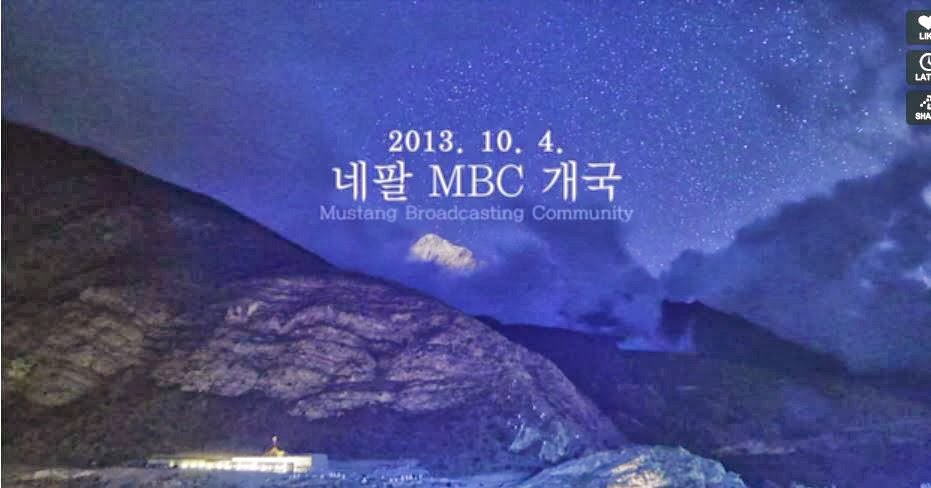
Wah.. this is such a great news. I just come to know of Mustang Broadcasting SCommunity (MBC), a joint collaboration of South Korea's second-largest public broadcaster, Korea, the Korea International Cooperation Agency (KOICA) and Lafuma, an outdoor fashion brand of LG Fashion and local community. I take this as a great example of collaboration between Korean and Nepali people.

Myself who has root in Mustang would like to express appreciation to MBC, Korea, KOICA and Lafuma.
http://media.daum.net/foreign/others/newsview?newsid=20131005082713175
http://vimeo.com/75943455
MBC will "produce programs for Mustang residents as well as mountaineers coming to hike Annapurna, a section of the Himalayas in north-central Nepal" as reported by http://english.yonhapnews.co.kr/culturesports/2013/09/30/41/0701000000AEN20130930005700315F.html
Myself who has root in Mustang would like to express appreciation to MBC, Korea, KOICA and Lafuma.
http://media.daum.net/foreign/others/newsview?newsid=20131005082713175
http://vimeo.com/75943455
MBC will "produce programs for Mustang residents as well as mountaineers coming to hike Annapurna, a section of the Himalayas in north-central Nepal" as reported by http://english.yonhapnews.co.kr/culturesports/2013/09/30/41/0701000000AEN20130930005700315F.html
Subscribe to:
Posts (Atom)